
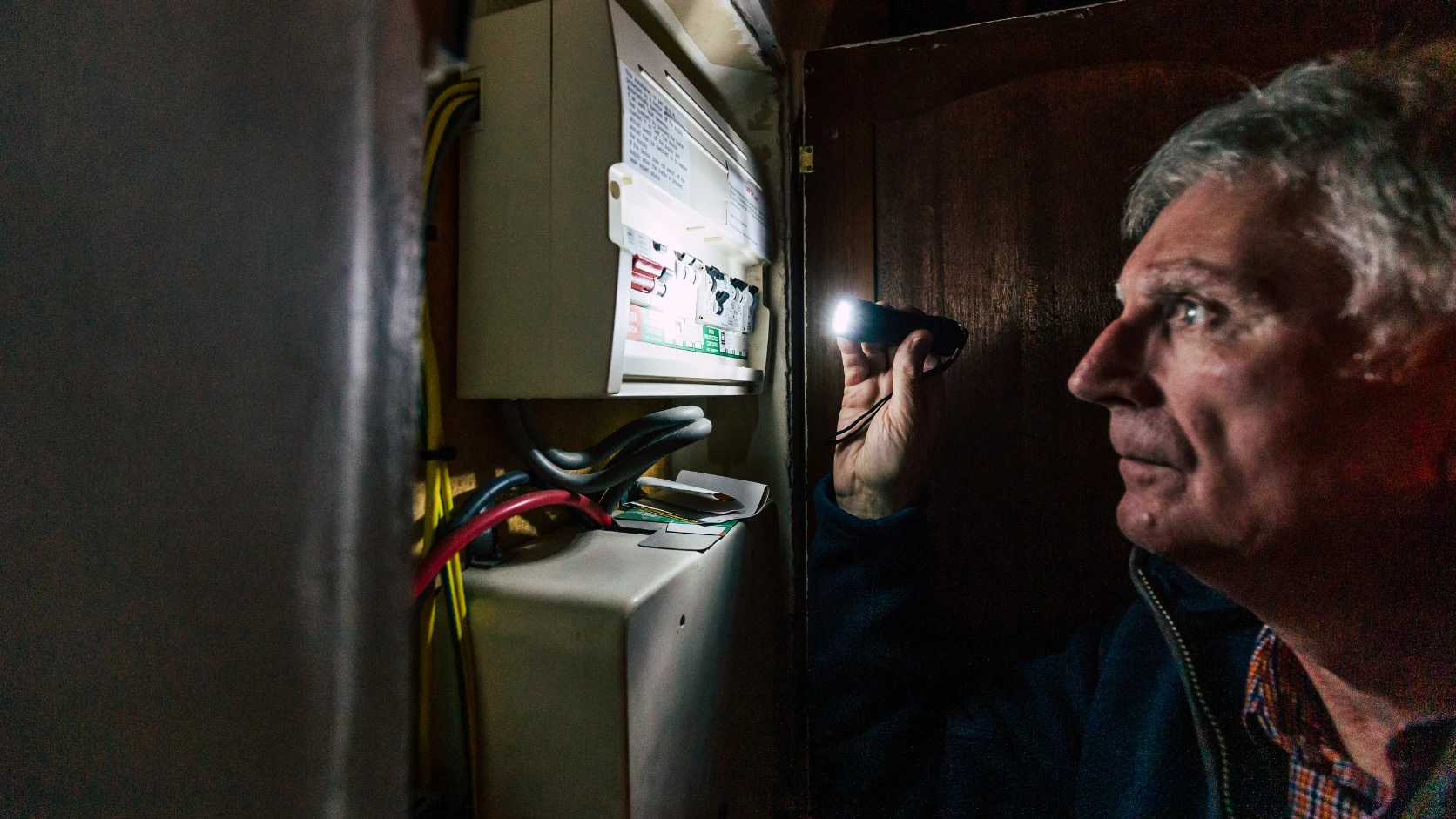
If half of the house has no power, the cause may be a tripped breaker, a GFCI, a failed wiring connection, or a problem with the panel or incoming electrical supply. A few dead outlets and several unrelated rooms losing power can point to different problems. Breakers that look normal do not rule out a fault. Unusually bright or dim lights need prompt attention.
You turn on the bedroom light, and nothing happens. The hallway is dark, but the kitchen still has power. You check the breaker box, and nothing looks obviously tripped. It is hard to know whether you are dealing with a simple circuit problem or something affecting the supply to your home.
The pattern of the outage matters. Which rooms stopped working? Are the lights completely out, or are some flickering or changing brightness? Did this happen after a storm, while an appliance was running, or right after the utility restored power? Those details help an electrician or your electricity provider determine where to investigate.
When Is Partial Power Loss an Urgent Problem?
Partial power loss needs prompt attention when it comes with burning odors, buzzing, sparks, shocks, or unusually bright and dim lights. Do not keep using affected equipment or repeatedly reset breakers to see whether the problem clears.
The Electrical Safety Foundation identifies flickering lights, overheating, unusual electrical noises, and shocks as warning signs that warrant an electrical inspection. You do not need to see a flame for a wiring problem to require help.
If there is smoke, fire, or active sparking, leave the affected area and call 911. Stay away from damaged electrical equipment and downed power lines. Do not approach a panel that is wet, damaged, buzzing, or smells like burning.
When some lights become unusually bright while others dim, stop using appliances and contact your electricity provider promptly. Tell them you have partial power and abnormal light brightness. An electrician may also be needed if the fault involves equipment or wiring on your property.
Why Can Some Rooms Have Power While Others Don’t?
Your home’s electrical circuits do not necessarily follow room boundaries. One circuit may supply outlets in more than one room, while a kitchen may have several separate circuits. A failed circuit connection can therefore affect a group of outlets without turning off every light nearby.
Most U.S. houses receive 120/240-volt electrical service with two incoming hot conductors, often called power legs. Ordinary 120-volt circuits use one leg and a neutral. Many larger appliances use 240 volts across both legs.
If one incoming leg loses its supply, multiple circuits can stop working while others remain energized. The affected rooms may be scattered throughout the house rather than located neatly on one physical side.
That is why “half the house” is a useful description of what you notice, but it is not a diagnosis. The cause could involve one branch circuit, a supply feeding several circuits, or the incoming service.
What Can Cause Half a House to Lose Power?
A Tripped Breaker or GFCI
A tripped branch-circuit breaker interrupts power to the circuit it protects. If that circuit supplies several rooms or a group of outlets, the outage may feel larger than expected.
A GFCI receptacle can also interrupt power to other outlets connected downstream of it. The reset device may be in a bathroom, garage, kitchen, or outdoor location rather than beside the outlet that stopped working. However, one GFCI would not normally explain a loss of power across several unrelated circuits.
If a GFCI will not reset, do not assume replacing it will solve the problem. Leviton explains that a GFCI may refuse to reset when it has no incoming power, among other causes. The interruption may be farther upstream.
A Loose or Failed Wiring Connection
A damaged connection can interrupt power even when the breaker remains on. When the failure occurs before other devices along a circuit, several outlets or lights may stop working together.
This is one reason replacing the first dead outlet you find can miss the actual problem. The fault may be at another connection supplying it. Our guide to an outlet that stopped working even though the breaker did not trip explains this circuit-level situation in more detail.
Finding that connection requires diagnosis. Opening outlets, pulling switches out, or tightening panel connections should be left to a qualified electrician.
A Main Breaker, Panel, or Subpanel Supply Problem
A fault in equipment supplying several circuits can produce a wider outage than a single branch-circuit problem. Depending on the home’s layout, a subpanel supply issue may affect an addition, garage, or another group of circuits.
The repair depends on what has failed. Partial power loss does not automatically mean the electrical panel needs replacement, and a panel upgrade should not be recommended solely because several rooms are dark.
Loss of One Incoming Power Leg
Sometimes the interruption involves one of the two hot conductors supplying the home. Circuits relying on that leg can lose power, and 240-volt equipment may fail to operate normally.
The cause may involve utility equipment, a service connection, or customer-owned electrical equipment. The outage pattern alone cannot establish who is responsible for the repair.
Do not turn on a dryer, range, or other large appliance to test this possibility or try to bring power back. Report the symptoms and let the utility or electrician assess the supply.
A Loose or Open Neutral
The neutral is a different conductor from either incoming hot leg. A faulty service neutral can cause unequal voltages on the home’s 120-volt circuits. Some lights may become unusually bright while others dim, and appliances may behave unpredictably.
This is different from simply losing one hot leg. It is also different from a neutral connection failing on one branch circuit, which may affect a more limited area.
Abnormal brightness is a warning pattern, not proof of a neutral fault. It calls for prompt professional investigation rather than continued appliance use or repeated resetting.
Why Is Half My House Without Power If No Breakers Tripped?
A breaker that appears on does not prove that its circuit has a usable electrical supply. Power may be interrupted before reaching the breaker, or a connection farther along the circuit may have failed.
If you have power out in half of the house but no breaker appears tripped, possible causes include an interrupted incoming power leg, a failed connection, or a fault in equipment feeding several circuits. If the outage affects only a small group of outlets, the investigation may instead focus on a branch circuit or GFCI.
Breakers respond to particular fault conditions. Not every interruption creates the conditions needed to trip one. That is why an electrician checks the supply and circuit connections rather than relying only on the handle position.
Repeatedly switching every breaker off and on is not a reliable way to diagnose a partial outage. It may also delay the investigation of a service or wiring fault.
What Can You Safely Check Before Calling for Help?
Start by observing the outage. You can gather useful information without opening electrical equipment or testing live wiring.
Identify What Stopped Working
Note the affected rooms, lights, outlets, and appliances. Tell the person you call whether the problem involves one area or several rooms that do not seem connected.
Do not plug additional appliances into affected outlets to experiment. Record what you have already noticed, including any unusual sounds or changes in brightness.
Check Your Electricity Provider’s Outage Information
Look for an outage affecting your address and note whether nearby homes are also without power. If neighbors are affected, mention that when you report the problem.
Neighbors having power does not establish that your home’s wiring is at fault. A supply problem can affect an individual property, and homes on the same street may not all receive power through the same equipment.
Look for a Clearly Tripped Protective Device Only If Access Is Safe
If the outage is limited to one circuit and there are no warning signs, you may be able to identify a tripped breaker or GFCI from its normal operating controls. Follow the manufacturer’s instructions or ask your utility or electrician for guidance.
Do not remove covers or approach wet, damaged, hot, or noisy equipment. If a device trips again, refuses to reset, or you are unsure what you are looking at, stop. A wider outage with abnormal brightness should be reported rather than treated as a routine reset.
Note When the Problem Started
Useful details include whether power failed during a storm, while an appliance was running, or after an outage ended. Also mention whether the interruption has happened before.
If your utility says power has been restored, but some areas remain without electricity, report the remaining problem. SMUD explains that another outage can remain after an initial restoration.
Should You Call the Electricity Provider or an Electrician?
Contact your electricity provider promptly when several unrelated circuits lose power, lights have abnormal brightness, or the problem appears connected to a utility outage or damaged service equipment. Arrange electrical troubleshooting when the problem is limited to household circuits or the utility identifies a customer-side fault.
You do not have to determine the ownership of every wire or connection before asking for help. Describe the symptoms accurately so the investigation can begin.
| What you notice | Who to contact |
|---|---|
| Several unrelated rooms lose power, especially after a storm or outage | Your electricity provider to report possible supply trouble; an electrician may also be needed |
| Some lights become unusually bright while others dim | Your electricity provider promptly for a possible voltage or service problem |
| A limited group of outlets remains dead or a protective device keeps tripping | A licensed electrician for circuit troubleshooting |
| Smoke, fire, active sparking, or downed power lines | Emergency services; stay away from the hazard |
For Sacramento-area homeowners, use the resources for the company that supplies your electricity. SMUD customers can use the SMUD Outage Center. PG&E electricity customers can use its voltage-problem reporting guidance, which specifically includes partial power, flickering lights, and high or low voltage.
Your natural gas provider may be different from your electricity provider, so check your electric bill if you are unsure whom to contact.
How Stones Electric Diagnoses Partial Power Loss
Stones Electric provides residential electrical troubleshooting for homeowners in Sacramento, Natomas, Citrus Heights, and nearby communities. We begin with what stopped working and assess the relevant supply, circuits, and equipment to find the cause before recommending repairs.
Depending on the symptoms, the investigation may involve affected outlets, GFCIs, breakers, wiring connections, the electrical panel, or a subpanel. If the findings point to utility-side trouble, we explain why the electricity provider needs to be involved.
Our $199 diagnostic visit covers the trip, professional diagnosis, and minor fixes we can handle on the spot. For repairs requiring extensive parts and labor, we credit the $199 toward the total job cost. We explain the repair and price before proceeding with additional work.
The diagnostic fee is a starting point for finding the problem. It is not a promise that every partial outage can be completely repaired for $199.
Frequently Asked Questions
Can a GFCI Cause Several Outlets to Stop Working?
Yes. A GFCI can protect additional outlets connected downstream of it, so a trip can leave several outlets without power. It would not normally interrupt unrelated circuits throughout the house. If multiple rooms and different types of equipment lose power together, a wider supply or panel problem also needs consideration.
Can a Utility Problem Affect Only My House?
Yes. Trouble with the equipment or service supplying an individual property can affect that home while neighbors still have electricity. Working streetlights or a neighbor’s illuminated windows do not rule out a supply issue. Report the affected circuits, abnormal light brightness, and when the problem began.
Why Do Some Lights Get Brighter While Others Get Dimmer?
That pattern can indicate a voltage problem, including a faulty service-neutral connection. It requires prompt investigation because electrical equipment may be receiving abnormal voltage. Stop using appliances and report the symptoms to your electricity provider. Do not keep switching appliances on to see how the lights respond.
What If Power Went Out in One Room but the Breaker Did Not Trip?
A single-room outage can involve a GFCI, a failed connection, or another problem affecting the circuit serving that room. Some outlets may be connected to a circuit that also supplies another area. If the cause is not clear from a safe visual check, an electrician can trace the interruption.
Why Is Power Still Missing After an Outage Ends?
There may be another supply interruption that has not been resolved, or a problem within your home’s electrical system. Report the remaining outage to your electricity provider, even if you received a restoration notification. Explain which parts of the house are still affected and whether lights or appliances behave unusually.
Does Partial Power Loss Mean I Need a New Electrical Panel?
No. The cause could be a protective-device trip, failed connection, utility supply problem, or a fault in existing equipment. A panel replacement may be appropriate if diagnosis identifies damage or another reason for replacement. The symptom alone does not establish that a new panel is necessary.
Need Help Finding the Cause of Partial Power Loss?
If part of your house has no power and the cause is unclear, Stones Electric can help investigate the affected circuits and explain the repair options. For homeowners in Natomas, our Natomas electrical troubleshooting service covers breaker problems, dead outlets, panel concerns, and residential power loss.
The $199 diagnostic visit includes the trip, professional diagnosis, and minor fixes handled on the spot. If repairs require extensive parts and labor, we credit the $199 toward the total job cost.
Call Stones Electric at (916) 347-8994 or book a diagnostic visit online. If you have widespread partial power with unusually bright or dim lights, contact your electricity provider promptly as well.