
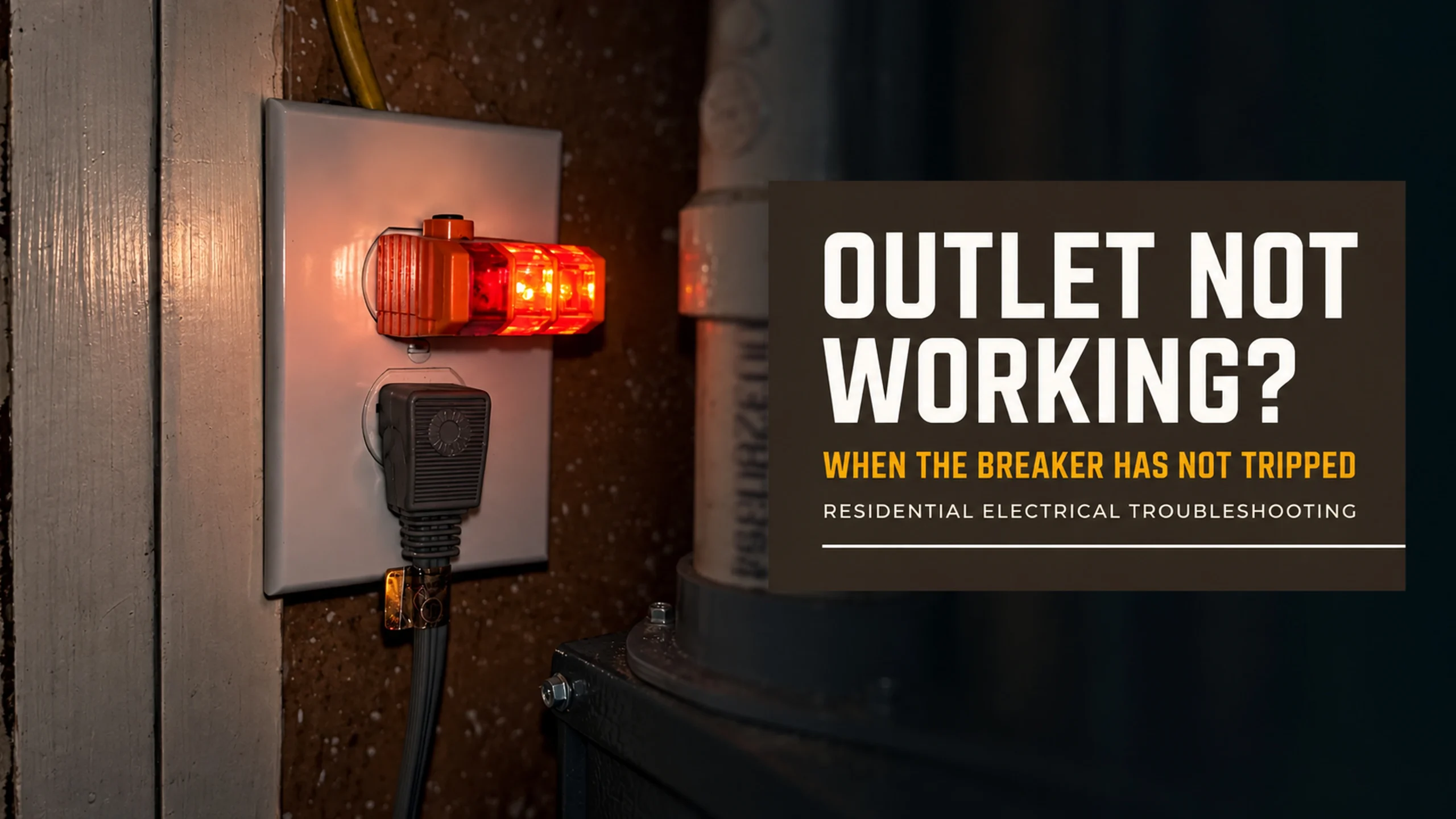
An outlet can stop working while the breaker remains on because a loss of power does not always create the overload or short circuit that makes a breaker trip. A nearby GFCI may have opened the circuit. The outlet itself may have failed. A loose connection at another receptacle can also cut power to everything farther along the same circuit.
Start with a lamp or small device that you know works, check nearby wall switches, and look for a tripped GFCI in the kitchen, bathroom, garage, laundry area, or outside. Stop using the outlet if you notice heat, discoloration, buzzing, sparks, or a burning smell. Those signs require a licensed professional electrician in California.
Why can an outlet lose power without tripping the breaker?
A circuit breaker responds to excess current and certain fault conditions. It does not react to every interruption in the path that carries electricity to a receptacle. If a wire connection opens, current can simply stop flowing. The outlet goes dead while the breaker stays in the on position.
The same thing happens when a GFCI receptacle trips. Its internal protection disconnects power at the GFCI and may also shut off several outlets connected after it. The breaker in the electrical panel can remain on throughout the event.
What are the most likely causes?
A GFCI has tripped somewhere else
A dead bedroom, hallway, garage, or outdoor outlet may receive power through a GFCI located in another part of the house. One GFCI can protect other receptacles downstream. If it trips, the outlets it protects lose power as well. Our guide to a GFCI outlet that will not reset explains why the reset button may refuse to stay in.
The Electrical Safety Foundation International explains that a GFCI monitors current leaving and returning to the circuit. It shuts power off when it detects leakage that could create a shock hazard.
A wall switch controls the outlet
Some rooms have a switched receptacle for a floor lamp. The switch may control the whole receptacle or only one half of it. A switch can be turned off accidentally during cleaning, furniture rearrangement, or other work in the room. Try the nearby switches before assuming the receptacle has failed.
The receptacle has worn out
Internal contacts can wear, loosen, or become damaged over time. A plug that no longer fits firmly is one warning sign. Dark marks, cracks, or melted plastic point to damage that should be inspected promptly. Leave the outlet unused until the cause is confirmed.
An upstream connection has opened
Residential receptacles are often connected in a sequence. A loose or damaged connection at one device can interrupt power to the next device on the circuit. The visible problem may be in the living room while the failed connection is inside a different outlet closer to the panel.
This is one reason replacing the dead outlet may fail to solve the problem. Circuit tracing is needed to find the last point with power and the first point without it.
The breaker handle has not moved far enough to look tripped
Some breaker handles move to a middle position that is easy to miss. A breaker may need to be moved fully to off before it can be reset to on. Do this once only when the panel is dry, accessible, and free of heat, odor, noise, or visible damage. Leave the breaker off if it trips again.
The breaker or another circuit component has failed
A breaker can fail internally, although other causes are more common. Damage at a splice, junction box, neutral connection, or panel can also interrupt power. These conditions require testing by a qualified electrician because the fault may sit behind a cover or inside energized equipment.
What can I check safely before calling an electrician?
Keep the checks limited to parts of the system designed for normal homeowner use. Do not remove the receptacle cover, pull the outlet from the box, or open the electrical panel cover.
- Unplug the device from the dead outlet and test it at a receptacle you know is working. A failed charger, lamp, or appliance can look like a dead outlet.
- Plug a small working lamp into both halves of the receptacle. This can reveal a switched half or a problem limited to one set of contacts.
- Turn nearby wall switches on and test the outlet again.
- Check GFCI receptacles in nearby rooms, the garage, outside areas, and other places where water may be present. Press RESET once. If it will not reset, leave it alone.
- Look at the breaker panel without removing its cover. If the correct breaker appears to be in the middle position, move it fully off and then on once, provided there are no warning signs at the panel.
- Write down which outlets, lights, or appliances have lost power. That information helps the electrician identify the circuit and narrow the fault location.
If power returns after a GFCI reset or breaker reset, pay attention to what was running when the problem occurred. A second trip indicates an unresolved fault. Repeated resets can expose damaged wiring or equipment to more stress.
When should I stop troubleshooting?
Leave the outlet unused and call an electrician when any of the following is present:
- The faceplate or plug feels warm or hot.
- You see brown marks, melting, cracks, or other damage.
- The outlet buzzes, crackles, sparks, or gives someone a shock.
- You smell burning plastic or another unusual electrical odor.
- Moisture has entered the outlet or electrical box.
- Several outlets are dead, and a GFCI reset does not restore power.
- The breaker trips again after one reset.
The U.S. Consumer Product Safety Commission advises homeowners to stop using an outlet or switch that feels unusually warm and have the wiring checked by a qualified electrician. Read the agency’s home electrical safety guidance.
Active smoke or fire requires everyone to leave the home and call 911. For other urgent warning signs, use our guide on when to call an emergency electrician in Citrus Heights.
Why can one failed connection affect several outlets?
A branch circuit may carry power through several electrical boxes. Each box can contain connections that continue the circuit to the next location. When an early connection fails, every downstream device can lose power even though the first few outlets still work.
The pattern matters. One dead receptacle may point to damage at that device. A group of dead outlets often points to a GFCI, an upstream connection, or another shared circuit problem. Testing identifies where voltage disappears instead of relying on the location of the most obvious symptom.
How does an electrician diagnose a dead outlet?
An electrician begins by confirming the affected locations and identifying the circuit. Testing then follows the electrical path from the panel through the devices and connections that feed the dead outlet. The goal is to locate the exact point where power stops and determine why it stopped.
Depending on the symptoms, the diagnosis may include:
- Checking the breaker and any GFCI or AFCI protection on the circuit.
- Testing for voltage and a complete neutral path at accessible points.
- Tracing the circuit to locate the last working device and the first dead device.
- Inspecting suspect receptacles and connections for looseness, heat damage, or failed components.
- Confirming that the repair restored normal operation and that the safety device functions correctly.
Stones Electric focuses on residential electrical troubleshooting in Citrus Heights and surrounding communities. The diagnostic process finds the cause before a repair is recommended.
How much does Stones Electric charge to diagnose a dead outlet?
Stones Electric offers a $199 residential electrical diagnostic visit. The visit covers the trip and minor fixes completed during the appointment. When the problem requires extensive parts and labor, the $199 is credited toward the qualifying repair.
Call (916) 347-8994 to describe the affected outlet and any warning signs. Mention whether a GFCI has tripped, how many outlets are dead, and whether the problem began after an appliance was used.
Frequently Asked Questions
Can an outlet fail without tripping the breaker?
Yes. A worn receptacle or an open connection can stop current from reaching the outlet without creating the excess current that trips a breaker. The outlet and its upstream connections need to be tested before the failed part can be confirmed.
Can a GFCI in another room shut off my outlet?
Yes. One GFCI can protect additional outlets connected downstream. A garage or outdoor outlet may be protected by a GFCI in another nearby location. Check each accessible GFCI and press RESET once.
Can one bad outlet cause other outlets to stop working?
Yes. A failed connection at one receptacle can interrupt power to devices farther along the same branch circuit. The dead outlets may be several feet away from the failed connection.
Why does only half of my outlet work?
A wall switch may control one half of the receptacle. Damage to the receptacle or its wiring can produce the same symptom. Test nearby switches first and stop using the outlet if the plug feels loose or the faceplate shows damage.
Should I replace the dead outlet myself?
Replacing the visible receptacle can miss an upstream fault, and the electrical box may contain energized conductors even when one outlet appears dead. A licensed electrician should handle the work when a GFCI reset and one breaker check do not restore power.
Is a dead outlet an electrical emergency?
A dead outlet by itself usually allows time to schedule service. Heat, smoke, sparks, buzzing, shock, melting, or a burning smell makes the problem urgent. Leave the circuit off when you can identify it safely. Call 911 if there is active smoke or fire.
Schedule electrical troubleshooting in Citrus Heights
A dead outlet can be caused by a simple reset or by a failed connection elsewhere on the circuit. Stones Electric traces the circuit, confirms the cause, and explains the repair before the work moves forward.

Residential Electrical Service
Request a $199 Residential Electrical Diagnostic Visit
Start with a professional diagnosis of the circuit, device or panel causing the problem in your home.
Covers the trip and minor fixes performed during the appointment.