
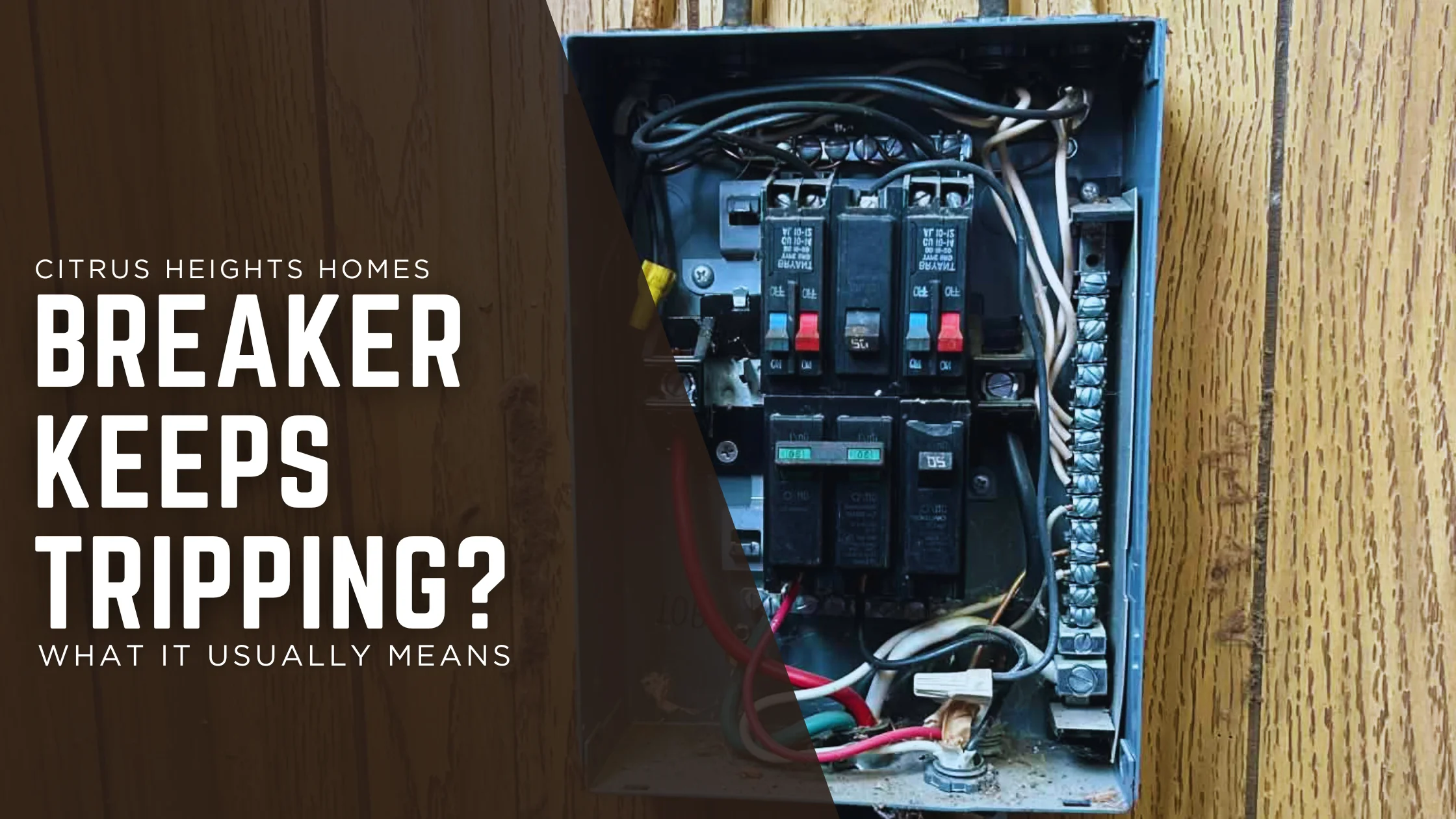
A breaker that keeps tripping usually means the circuit is overloaded, something is loose, or one appliance is pulling more power than the circuit can handle.
Sometimes it’s simple. Someone plugs in a space heater, the microwave is running, and the breaker shuts off. That happens.
When the same breaker keeps tripping again and again, the circuit needs to be checked. Resetting it every few hours doesn’t fix the cause. It only turns the power back on for a while.
We see this a lot in Citrus Heights homes. Older bedrooms are now home offices. Garages have freezers, tools, chargers, and workout equipment. Kitchens have more appliances than the original wiring was built around. Some homes have added EV chargers or larger HVAC equipment. All that extra load has to go somewhere.
Stones Electric handles [electrical troubleshooting in Citrus Heights, CA] for homeowners dealing with tripping breakers, flickering lights, dead outlets, GFCI issues, buzzing sounds, and burning smells near outlets or panels.
If your breaker keeps tripping, pay attention to when it happens. That timing usually tells us a lot.
Why Your Breaker Keeps Tripping
A circuit breaker shuts power off when a circuit has a problem. It protects the wiring from carrying more current than it should.
A breaker may trip because:
- Too many devices are running on one circuit
- One appliance is pulling too much power
- A wire or connection is loose
- An outlet or switch is damaged
- The breaker is weak or failing
- There’s a short circuit
- There’s a ground fault
- The panel or circuit is outdated for the home’s current load
One trip can happen from a temporary overload. Maybe someone ran two high-demand appliances at the same time.
Repeated trips are different. If the same breaker keeps shutting off, the circuit is reacting to something. That problem should be found before it gets worse.
The Circuit May Be Overloaded
Overloaded circuits are one of the most common problems we find on troubleshooting calls.
A circuit is overloaded when the devices connected to it are asking for more power than the circuit can safely handle. This comes up often in kitchens, garages, laundry rooms, older bedrooms, and home office spaces.
You might notice things like:
- The microwave trips the breaker when another appliance is running
- A space heater keeps shutting off power to a bedroom
- Garage tools trip the breaker when a freezer is also running
- A washer or dryer causes repeated trips
- A portable AC unit shuts off power in one room
- A home office setup overloads an older bedroom circuit
- EV charging equipment causes breaker problems after installation
A lot of homeowners assume the breaker is bad. Sometimes it is. Many times, the breaker is doing its job because the circuit is overloaded.
Replacing the breaker without checking the load can leave the same problem in place. The circuit needs to be tested. The panel should also be checked to see how the home is using power.
The Appliance May Be the Problem
A breaker issue can start with one appliance.
If the breaker trips only when you use one specific appliance, that appliance may be pulling too much power or it may have an internal problem. This can happen with microwaves, refrigerators, dishwashers, washing machines, dryers, garage freezers, power tools, portable AC units, space heaters, and EV chargers.
The pattern matters.
If the breaker trips every time the microwave starts, that tells us something.
If it trips only when the garage freezer kicks on, that tells us something else.
If it trips right after plugging in a tool, charger, or portable heater, the problem may be tied to that device or the circuit feeding it.
Don’t keep using an appliance that trips the breaker every time. The issue may be inside the appliance, at the outlet, or somewhere on the circuit. That’s the kind of problem that should be checked before the wiring gets hot or the outlet gets damaged.
Short Circuits and Ground Faults Need Fast Attention
Some breaker trips are more urgent.
A short circuit can trip a breaker immediately. A ground fault can do the same thing. These problems can come from damaged wiring, moisture, a bad outlet, a loose connection, or a faulty device plugged into the circuit.
Pay close attention if you notice:
- A breaker trips as soon as you reset it
- An outlet has burn marks
- A switch plate feels warm
- You smell something hot or burnt
- You see sparks
- A GFCI outlet keeps tripping
- You hear buzzing near the panel, outlet, or switch
A burning smell near an outlet or panel should be treated seriously. Turn off the circuit if you can do it safely and call an electrician.
The same goes for a breaker that trips immediately. That usually means the problem is still active.
Common Breaker Symptoms and What They Point To
Breaker problems tend to show up in a handful of recognizable ways. The table below matches the most common symptoms to their likely causes and the right next step. It’s a starting point for understanding what’s happening, not a replacement for having the circuit checked.
| What the breaker is doing | Likely cause | What to do |
|---|---|---|
| Trips only when several things run at once | Circuit overload | Move some devices to another circuit, then have the load checked |
| Trips the moment you reset it | Short circuit or ground fault | Stop using the circuit and have it inspected |
| Trips only when one appliance runs | Faulty appliance or undersized circuit | Test the appliance elsewhere; have the circuit checked |
| Lights flicker, then the breaker trips | Loose connection or overload | Have the wiring and panel inspected |
| Breaker or outlet feels warm, with a burning smell | Overheating connection or damaged wiring | Stop using it and call an electrician right away |
| GFCI outlet won’t reset | Ground fault or moisture on the circuit | Check the outlets it controls, then have it tested |
Older Citrus Heights Homes Can Have Electrical Limits
Many Citrus Heights homes were built before today’s electrical demand became normal.
A bedroom circuit that once handled a lamp and small TV may now power a computer, printer, charger, gaming setup, and space heater. Garages are another common problem area. People add freezers, tools, battery chargers, gym equipment, and sometimes EV charging.
Kitchens also put heavy demand on a home’s electrical system. Microwaves, dishwashers, refrigerators, garbage disposals, countertop appliances, and lighting can put pressure on older circuits when everything is in use.
That doesn’t mean every older home needs a panel replacement. Some homes only need a repair. Some need a dedicated circuit. Others need the panel checked because the home has outgrown the original setup.
During a troubleshooting call, we look at how the circuit is actually being used. The cause isn’t always sitting right at the breaker.
Flickering Lights Can Point to the Same Problem
Flickering lights can be simple. A loose bulb can cause it.
When lights flicker across several rooms, dim when a large appliance starts, or flicker before a breaker trips, the problem may be on the circuit or at the panel.
Common causes include loose wiring, overloaded circuits, poor connections, or high-demand equipment starting up. HVAC systems can also cause lights to dim when they kick on, especially if the panel or circuit is already under stress.
A quick flicker once in a while may not mean there’s danger. Repeated flickering should be looked at. The concern goes up when the flickering happens with breaker trips, warm outlets, buzzing, or burning smells.
Dead Outlets Can Be Part of the Same Circuit Issue
A dead outlet doesn’t always mean the outlet itself failed.
It may be connected to a tripped breaker, a GFCI outlet, a loose wire, or a damaged receptacle. In garages, bathrooms, kitchens, and outdoor areas, one GFCI outlet can affect other outlets downstream. That’s why an outlet can stop working even though the problem started somewhere else.
Before calling, you can check a few basic things:
- Look at the breaker panel and see if one breaker has tripped
- Check nearby GFCI outlets and press reset if it’s safe
- See whether other outlets in the room are also dead
- Think about what was plugged in when the power went out
Stop using the outlet if it feels warm, smells burnt, sparks, or has visible damage. That outlet needs to be inspected.
When to Stop Resetting the Breaker
Resetting a breaker once after a temporary overload is common.
Resetting the same breaker every day is a warning sign.
Call an electrician if:
- The same breaker keeps tripping
- The breaker trips right away after you reset it
- The breaker feels hot
- You smell burning
- You hear buzzing
- Lights flicker before the breaker trips
- An outlet or switch feels warm
- You see burn marks
- A GFCI outlet won’t reset
- The problem started after adding new equipment or appliances
A breaker is a safety device. If it keeps shutting off, something on that circuit needs attention.
Don’t tape a breaker in the on position. Don’t replace it with a larger breaker. Don’t keep forcing the circuit back on without knowing why it tripped. Those shortcuts can create a bigger problem.
What Stones Electric Checks During Troubleshooting
Electrical troubleshooting starts with the symptom, then we work backward.
If the breaker keeps tripping, we want to know what room lost power, what was running, whether the breaker trips right away, and whether the issue happens at a certain time of day.
From there, Stones Electric may check:
- The electrical panel
- The breaker
- Circuit load
- Outlets and switches
- GFCI outlets
- Wiring connections
- Appliances tied to the circuit
- Signs of overheating
- Signs of loose or damaged wiring
Sometimes the problem is obvious once the panel is opened. Other times, the issue is further down the line at an outlet, switch, junction, or appliance.
Guessing gets expensive. A homeowner may replace an outlet when the issue is a loose connection elsewhere. Someone else may assume they need a new panel when the real issue is one overloaded circuit.
A proper diagnosis helps make the repair clear.
When the Fix Requires a Dedicated Circuit
Some breaker problems come from one appliance or one area of the home needing its own circuit.
A dedicated circuit gives a specific appliance, outlet, or piece of equipment its own path back to the panel. This helps keep high-demand equipment from sharing power with other devices.
A dedicated circuit may be needed for a:
- Microwave
- Refrigerator or freezer
- Dishwasher
- Washer or dryer
- Garage tool setup
- HVAC equipment
- EV charger
- Home office setup
- Large shop tool
If an appliance keeps tripping a shared circuit, a dedicated circuit may solve the problem. The panel still needs to be checked first. There has to be enough capacity, and the circuit has to be sized properly.
When Panel Work May Be Needed
Breaker problems can also point back to the panel.
Panel work may be needed if breakers are loose, the panel is crowded, there are signs of heat damage, or the home needs more circuits than the existing panel can safely support.
This is common when homeowners add EV chargers, larger appliances, garage equipment, or remodel work. A panel that worked fine years ago may struggle once the home’s electrical use changes.
Panel replacement isn’t the automatic answer to every tripping breaker. We inspect the problem first, then explain what we find.
If the panel is part of the issue, we’ll say so. If the issue is only one bad outlet or one overloaded circuit, we’ll say that too.
What You Can Do Before the Electrician Arrives
A few notes can help us diagnose the issue faster.
Before the service call, write down:
- Which breaker trips
- Which room loses power
- What appliance was running
- Whether the breaker trips immediately or after a few minutes
- Whether lights flicker before the trip
- Whether any outlets feel warm
- Whether the issue started after adding new equipment
Don’t take outlets apart. Don’t open the panel. Don’t remove switches. Just pay attention to the pattern.
That pattern often points us in the right direction.
Call Stones Electric for Breaker Problems in Citrus Heights
If your breaker keeps tripping in Citrus Heights, Stones Electric can inspect the circuit, find the cause, and recommend the right repair.
The issue may be an overloaded circuit, faulty breaker, damaged outlet, loose connection, appliance problem, older wiring, or panel-related issue. Once we find the source, we’ll explain what’s going on in plain language.
Call Stones Electric at (916) 347-8994 to schedule electrical troubleshooting in Citrus Heights and nearby areas.
FAQs
Why does my breaker keep tripping?
A breaker may keep tripping because the circuit is overloaded, the breaker is weak, an appliance is faulty, or there’s a wiring issue on the circuit. If the same breaker keeps shutting off, the circuit should be checked.
Is it safe to keep resetting a tripped breaker?
Resetting a breaker once may be fine after a temporary overload. If the same breaker keeps tripping, call an electrician and have the circuit inspected.
Can a bad appliance trip a breaker?
Yes. If the breaker trips only when one appliance is used, the appliance may be pulling too much power or may have an internal electrical problem.
Why does my breaker trip when I use the microwave?
Microwaves can pull a lot of power. If the microwave shares a circuit with other kitchen appliances, the circuit may overload. The microwave itself may also have a problem.
Why do my lights flicker before the breaker trips?
Lights may flicker because of loose wiring, overloaded circuits, panel issues, or high-demand equipment starting up. If flickering happens often or comes with breaker trips, the system should be inspected.
Should I replace the breaker myself?
No. A breaker may be tripping because of a problem somewhere else on the circuit. Replacing the breaker without diagnosing the cause can leave the unsafe part untouched.
When should I call Stones Electric?
Call Stones Electric if the same breaker keeps tripping, the breaker trips immediately, outlets feel warm, lights flicker repeatedly, a GFCI won’t reset, or you smell burning near an outlet, switch, or panel.